
Background of the case
In a recent ruling, the Delhi Income Tax Appellate Tribunal, (hereinafter referred to as “the Tribunal” or “ITAT”), in the case of Seaview Developers Private Limited1 (“the Assessee”), considered the question of whether a scheme of capital reduction under the Companies Act, 1956, approved by the Hon’ble Bombay High Court, could be treated as a buy-back of shares for the purpose of levying additional income tax under Section 115QA of the Income-tax Act, 1961 (“the Act”).
While the ruling addressed various issues including disallowance of interest expense on borrowed funds utilised for capital reduction, disallowance of interest on Compulsorily Convertible Debentures, disallowance of property management fees, and disallowance of depreciation on building and plant and machinery, this summary is confined to the treatment of a court-approved capital reduction scheme as a buy-back of shares for the purpose of levying additional income tax under Section 115QA of the Act.
Facts of the case
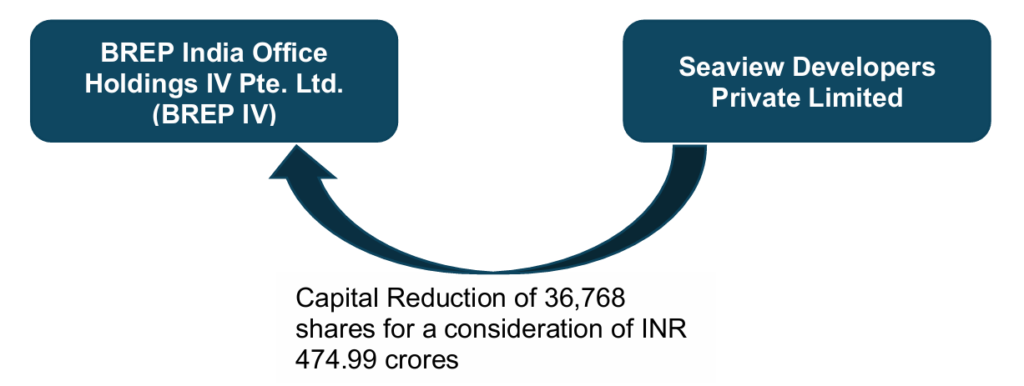
- The Assessee, engaged in the business of developing commercial real estate, implemented a court-approved capital reduction under Sections 100-104 of the Companies Act, 1956. Pursuant to the scheme approved by the Bombay High Court, a portion of the shares held by its shareholder, BREP India Office Holdings IV Pte. Ltd., was cancelled based on an independent DCF valuation.
- Pursuant to the capital reduction, the Assessee paid consideration to its shareholder and treated the distribution to the extent of accumulated profits as deemed dividend under Section 2(22)(d) of the Act, on which dividend distribution tax under Section 115-O was paid.
- The Assessing Officer held that the transaction was, in substance, a buy-back of shares and accordingly sought to levy tax under Section 115QA of the Act. The Commissioner of Income-tax (Appeals) upheld the Assessing Officer’s view.
- Aggrieved by the above order, the Assessee appealed to The Tribunal.
Key Issues
- Whether a court-approved scheme of capital reduction under Sections 100 to 104 of the Companies Act, 1956 constitutes a “buy-back” of shares within the meaning of Section 115QA of the Act?
- Whether the amendment to Section 115QA introduced by the Finance Act, 2016, which expanded the definition of buy-back to cover purchases under any law relating to companies, had the effect of bringing a capital reduction scheme under Sections 100 to 104 of the Companies Act, 1956 within the scope of Section 115QA?
- Whether the entire arrangement of capital reduction could be characterised as a colourable device intended to evade tax, having regard to the taxes discharged on the total consideration in the hands of the shareholder?
Key Takeaways
- Capital reduction and buy-back are distinct transactions under the Companies Act and the Act
- The Tribunal held that both the Companies Act, 1956 and the Act recognise capital reduction and buy-back as distinct transactions entailing separate scheme and treatment under the respective statutes. The term “buy-back” is defined under Section 115QA of the Act to mean “purchase by a company of its own shares.” In the Assessee’s case, the shares held by BREP IV were directly cancelled without the property in the shares passing to the Assessee. The cancellation of shares therefore cannot constitute a “sale” by BREP IV to the Assessee or a “purchase” by the Assessee.
- The Tribunal noted that capital reduction involves direct cancellation of shares without actual acquisition of shares by the company undertaking the reduction. The shares are extinguished on sanctioning of the scheme by the High Court or NCLT. By contrast, a buy-back requires the company to take physical delivery of shares or have them credited to its DEMAT account before they are extinguished. The Tribunal further noted that capital reduction requires prior court or NCLT approval, whereas buy-back does not.
- The Tribunal highlighted the functional difference between the two: a capital reduction is at the volition of the Company and for its benefit, in as much as it reduces the capital the Company is required to service going forward; a buy-back, though also at the volition of the Company, is for the benefit of the shareholder, in as much as the shareholder can exit at a price of his satisfaction.
- Reliance was placed on the Bombay High Court ruling in Capgemini India (P.) Ltd.2 and the Andhra Pradesh High Court ruling in Chetan G. Cholera v. Rockwool (India) Ltd.3, where it was held that every reduction of share capital does not amount to a buy-back, and that opting for capital reduction cannot be characterised as a colourable device merely because it does not attract income tax. The coordinate bench decision in Goldman Sachs (India) Securities (P.) Ltd. v. ITO4 was also relied upon for the same distinction.
- The Finance Act, 2016 amendment to Section 115QA did not bring capital reduction within its scope
- The Tribunal held that the amendment introduced by the Finance Act, 2016, which replaced the reference to “section 77A of the Companies Act, 1956” with “any law for the time being in force relating to companies,” was intended only to cover buy-backs undertaken under provisions other than Section 77A, such as Sections 391 to 393 of the Companies Act, 1956. The amendment was not intended to include capital reduction effected under Sections 100 to 104 of the Companies Act, 1956.
- The Tribunal drew support from the ITAT Chennai ruling in Cognizant Technology Solutions India (P.) Ltd. v. ACIT5 and from the proviso to Rule 40BB(3) of the Income-tax Rules, 1962, which makes it evident that buy-back and capital reduction are distinct. The proviso specifically recognises that any sum returned to a shareholder in a capital reduction could be treated as dividend under Section 115-O and therefore should not be reduced. This cross-reference confirms that the legislature treated the two as separate categories.
- Colourable device allegation unsustainable where taxes have been discharged on the entire consideration
- The Tribunal held that the AO’s allegation that the entire arrangement was a colourable device could not be sustained, having regard to the totality of the transaction. The accumulated profits component of INR 136.75 crore had already been subjected to DDT under Section 115-O, credit for which was granted by the AO himself. The balance net consideration of INR 338.24 crore had been offered to tax as short term capital gains of INR 17.14 crore by BREP IV in its return of income filed in India, which was accepted by the Revenue under Section 143(1).
- Relying on the Supreme Court’s “look at” principle articulated in Vodafone International Holdings B.V. v. Union of India6, the Tribunal held that the AO was required to consider the entire arrangement as a whole and not in piecemeal. The fact that the AO had provided credit for DDT while simultaneously alleging a colourable device was internally inconsistent and could not be sustained.
Conclusion
The Delhi ITAT allowed the appeal of the Assessee on this issue, holding that the reduction of share capital undertaken by the Assessee pursuant to a scheme sanctioned by the Hon’ble Bombay High Court under Section 100 to 104 of the Companies Act, 1956 could not be treated as a “buy-back” of shares within the meaning of Section 115QA of the Act. The Tribunal held that capital reduction and buyback are distinct transactions recognised as such under both the Companies Act, 1956 and the Act, that there was no substance in the allegation of a colourable device, and that the levy of tax under Section 115QA and interest under Section 115P on such a scheme is legally unsustainable on the transaction of reduction of share capital was liable to be quashed.
Kretha Comments
This ruling reiterates that capital reduction and buy-back continue to be distinct statutory mechanisms, and the tax treatment may ultimately depend on the legal character of the transaction and the provisions under which it is undertaken.Where a company implements a court-approved capital reduction, the Tribunal’s reasoning suggests that the transaction may not automatically be equated with a buy-back merely because shares are cancelled and consideration is paid to the shareholders.
Leave A Comment